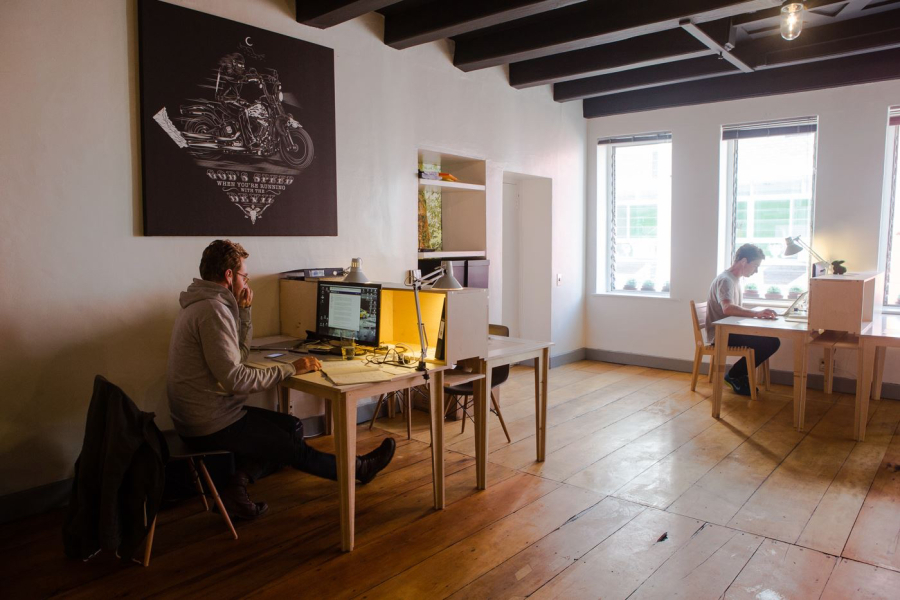
From aspirational young adults challenging society’s perceptions to trailblazing techies breaking boundaries and creatives dreaming up bold designs, Cape Town’s freelancers and entrepreneurs are getting together to share their skills and ideas, as well as other essentials such as meeting space and kitchen facilities. The Cape Town Central City Improvement District (CCID) fills you in on the CBD’s coworking culture, with insights from those who know it best.
Colombian Marcela Guerrero Casas has become somewhat of a celebrity among Mother City millennials. She is known for co-founding the local chapter of Open Streets in 2012, a concept that has made many of Cape Town’s citizens rethink the notion of public space. It was inspired by Bogotá’s Ciclovía, a recreational programme that turns 120km of street in that city into car-free space every Sunday. The first Open Streets Cape Town transformed the suburb of Observatory’s Lower Main Road into a pedestrian mall in May 2013, and subsequent events took place in Salt River, Langa and Bree Street in the CBD (aka the Central City).
Open Streets allows people to “walk, cycle, skate and connect” on tarmac normally reserved for cars. So when Marcela went looking for office space of her own, it’s hardly a surprise that she gravitated away from the norm.
In March 2015, Open Streets Cape Town moved its operation into 75 Harrington, a coworking block in Cape Town CBD’s East City district. Marcela says she chose coworking over regular office space “largely because of the affordability, but also because [75 Harrington] was such a welcoming space. In addition, this part of town tends to attract quite a diverse group of people which resonates with our ethos”.
75 Harrington has been named Cape Town’s “most happening and hip work hub” by the Weekend Argus. It is backed by the Cape Craft and Design Institute and 50% owned by Steven Harris, who stresses that collaboration between coworkers is of prime importance to the success of a coworking space: “It’s up to the owner of such a space to network among those who rent in it, and encourage them to engage with the rest of the community and offer their services. This is what differentiates a coworking success story from other shared spaces.”
Coworkers get a workstation with a desk and chair or a private office; fast and stable internet; 24/7 security 365 days a year; access to services such as printing, a phone, basic cleaning and kitchen facilities; meeting space and private areas. The building also has a ground-floor coffee shop and salad bar called Chopchop, and is in the heart of the CBD’s “innovation district”.
Approximately 50 people work at 75 Harrington and they are asked to buy into the values of the space: “To be open, flexible, dynamic, accessible, engage with serendipity, have a presence in the building, and share,” explains Steven.
Marcela, who was recently added to the list of 200 Young South Africans 2015 by the Mail & Guardian, shares a desk for two in a semi-private office. “So we have the privacy that’s needed to complete our tasks but we are also exposed to a large number of interesting projects, some of them of great relevance to Open Streets,” she says.
“75 Harrington has been crucial to the survival of our organisation; not only because it has offered us an affordable space but also because we have had an incredible level of support from Steven and his team. It is a space where many different people come together and bring interesting networks.”
Indeed, it can be a lonely world for a free agent. It’s largely because of this that the concept of coworking – coined in 2005 in San Francisco to describe an environment in which like-minded freelancers and entrepreneurs co-exist – has become so popular so fast. According to research conducted by the CCID, one multinational, Regus, has even made it a global business. It has set up 2 300 “business centres” in 106 countries – many in large, corporate-like environments, and you can find them in South African cities such as Pretoria, Johannesburg and Cape Town.
In Cape Town, however, the majority of coworkers tend to set up shop in less formal environments such as 75 Harrington. Most of the city’s coworking spaces reflect this, with the Cape Town Central City being home to a third of the 28 ventures currently in operation across the metropole.
Says Rob Kane, chairperson of CCID: “Entrepreneurs are finding their feet in our CBD’s coworking spaces. Many of these house a large portion of the Central City’s creative industries – important contributors to employment and economic opportunity in our area, and a vital component to a thriving, vibrant downtown. But they’re also becoming increasingly popular with individuals from other professions who want to engage and collaborate with others.”
The Inner City Ideas Cartel (IC|IC) is another prominent Cape Town CBD coworking hub. It’s located across town at 71 Waterkant Street, and has a diverse range of coworkers – from small law firms and PR practitioners to IT specialists, recruitment agencies and those involved in advertising. The concept has been so successful that an additional IC|IC opened in Loop Street in August. The key to its success, says owner Schuyler Vorster, is: “You need to have a service-orientated attitude. It’s your responsibility to help people work better.”
At IC|IC, you can sign up for anything from desk in the open-plan space to a semi-private or shared office to a private office plus ensuite bathroom and shower, or even a private office seating up to six staff members. Rates include all the usual amenities and services expected of a coworking space. There is also a drop-in rate as well as the use of a clubhouse (offering meeting space and a rooftop lounge).
Monya Eastman is a furniture designer who divides her working week between a “noisy, dusty” factory and the “quiet, inspiring and beautiful” IC|IC in Waterkant Street. “It’s my ‘working hotel’,” she says, “a space to do my design and admin work.”
She continues: “If I were renting my own office, I’d be responsible for things such as cleaning, electricity and air con. But everything is taken care of at the Ideas Cartel, and I can just get on with my work.”
Coworking has been beneficial to Monya’s business, Stokperd, in that she’s been able to bounce ideas off other people in the space. “When you’re stuck on a design, you can ask someone from a completely different background for input.”
Batstone, a team of strategists who help tech startups, funders, and emerging companies take their products to market and access funding, is also based at the IC|IC in Waterkant Street. Brendan Wade started Batstone in 2013 and was soon joined by Sarah Rice, who he met when the pair worked at 22seven.
“Like any company, and especially as a startup, you need to manage your available cash flow wisely,” says Brendan. “This means that having to enter into a long-term lease and fitting out a whole office from scratch – furniture, phone lines, internet access etc – is a very costly exercise. A coworking space is, therefore, the perfect starting point: all your basic needs are fulfilled and you can immediately start doing what you actually want to do: bring your company to life!”
He says the IC|IC has many advantages: “It’s conveniently situated in the heart of Cape Town, which means that we are able to visit all our clients within minutes. Additionally, it is also a place that you can welcome clients, meaning that it is highly representative.”
Batstone has grown significantly since Brendan and Sarah first joined the IC|IC. From a small office space for two people, they have ended up in a suite that accommodates six. “And then there are the small things like ordering your coffee, water and even lunch from the convenience of your desk via Skype that just pulls it all together.”
Other Cape Town Central City coworking spaces include The Extension at 114 Bree Street, Twenty Fifty at 8 Spin Street, No80 Hout Street (graphic designer and DJ/producer Bruno Morphet’s home base) and La Macchina Workspace at 84 Shortmarket Street. The latter is attached to The House of Machines, itself a mixed-use space with a motorbike workshop, café, live music and menswear on sale.
Coworking costs in these venues range from R1 600 per month for a desk in an open-plan office up to R15 000 per month for a private office seating up to six. Many facilities also offer a pay-per-day rate, usually in the region of R250, where drop-ins can use the same shared services enjoyed by permanent tenants.
One of the biggest benefits of coworking is the opportunity to be around and interact with like-minded people and businesses. “Networking becomes a natural process,” Brendan says. “And working alongside other startups can introduce you not only to great ideas but also amazing business opportunities. The entrepreneurial energy in a coworking space is highly empowering and motivating.”
Open Streets Cape Town: www.openstreets.co.za
75 Harrington: www.facebook.com/75-Harrington-375847012569272
Regus: www.regus.co.za
Inner City Ideas Cartel: www.ideascartel.com
Stokperd: www.stokperd.com
Batstone: http://batstones.com
The Extension: www.theextension.co.za
Twenty Fifty: http://twentyfifty.co
No80 Hout Street: www.coworkingcapetown.co.za
La Macchina Workspace: www.facebook.com/lamacchinaworkspace