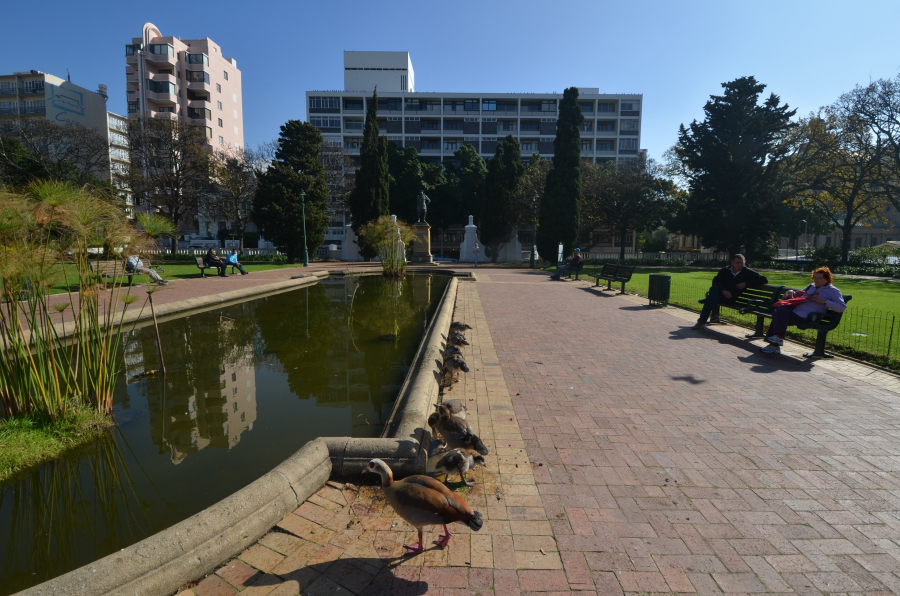
The results of the latest annual residential survey conducted at the end of 2017 by the Cape Town Central City Improvement District (CCID) has revealed that residents living in Cape Town’s downtown feel very much at home.
According to Carola Koblitz, CCID Communication manager and editor of the organisation’s annual investment guide (The State of Cape Town Central City Report), the dipstick survey has been conducted online since 2013, and while results on the whole have remained relatively constant from year-to-year, there have been some interesting shifts over the course of the past 12 months, in comparison to 2016’s results.
Among these, notes Carola: “While the respondents are still split around 50/50 between those who own the units they live in and those who rent, what is clearly evident is that people are now staying in their apartments for a number of years – well beyond three years and upwards. There has been a huge jump in particular in the number of people who now say they have been living in the Central City for more than 10 years. In 2014, for example, only 15% of respondents indicated they had been living in the CBD for more than 10 years. In the latest 2017 survey, this now sits at 32% – more than double.
“What this shows us is that the downtown is building a solid neighbourhood community of loyal residents, living mostly in buildings that were once upon a time office blocks. Before the mid-2000s ̶ with the exception of a few residential complexes that had existed for decades – there were very few residential units in the Central City. The CBD itself was largely a business and retail area. Today, it is home to thousands of people, who occupy it 24/7. Of course, they ‘share’ this neighbourhood with the hundreds of thousands who work or study here, but who only experience it during daytime hours.”
Central City estimated to have around 3 800 residential units in its footprint
While the exact number of residents is unknown – and will be until the next official census takes place – it is estimated that the Central City currently has around 3 800 residential units in its footprint. “This means that, conservatively, it has the potential for a residential community of around 7 000 residents. But it is impossible, without an official census, to know exactly how these units are occupied – whether that be for residential purposes, Airbnb, by owners living elsewhere who use their units for corporate or holiday purposes, or even as business premises for day-to-day office workers.”
In terms of age, while Millennials (27% of respondents between 24 and 34 years of age) still made up the largest group of respondents to the survey, there has been a significant increase in the responses of those aged 55 and older. In 2016, this stood at 13%, while for 2017 this rose to 20%.
“We believe this correlates with another result from the 2017 survey, that speaks to the reason why people choose to live in the CBD, and this is to be closer to their place of work. In 2016, this stood as the number one reason for 58% of respondents but in the latest survey this has now risen to 68%. In my opinion, it probably has quite a bit to do with empty-nesters, who are now finding themselves in big empty homes in the suburbs and who realise that – with the kids gone – they can now opt for a more convenient albeit also more compact lifestyle.”

The second reason for choosing to live in the CBD – and very close to the first – is that people felt the downtown was a prime business location and wished to be close to it (which had risen from 40% in 2017 to 46% in 2017). A surprise came in the third most popular reason: while in the 2016 survey, this had been in order to be close to entertainment options (39%), this year the reason chosen was quick access to other neighbourhoods in Cape Town (35%). Other reasons cited in the top six for 2017 included the desire for a “downtown” lifestyle as well as the desire to be close to great restaurants and good public transport options.
“Clearly,” says Carola, “Cape Town is experiencing the global movement of people wanting to return to traditional downtowns and a great deal has to do with the time and money they spend each day trying to get to and from work. What is also interesting in the latest survey is that the majority of respondents also referred to themselves as a ‘local’ (coming from Cape Town) and as opposed to coming from elsewhere in the Western Cape, South Africa or even abroad. This figure stood at 40% in the latest survey, versus 33% in 2016.”
The creative and knowledge industries continued to rule in 2017 as professions among CBD residents, with those involved in media, marketing and communications leading (15% of respondents), followed by creative industries involving film, fashion, animation, arts and entertainment (10%), architects and engineers, and those involved in ICT jointly third (7% each) and those involved in the food and beverage industry as well as property coming in at fourth (6% each), knocking those involved in the financial sector off this position in 2016.
The full results of the CCID’s 2017 online residential survey will appear in the next edition of the organisation’s State of Cape Town Central City Report: 2017 in review, due out towards the end of March 2018.
Images by the CCID