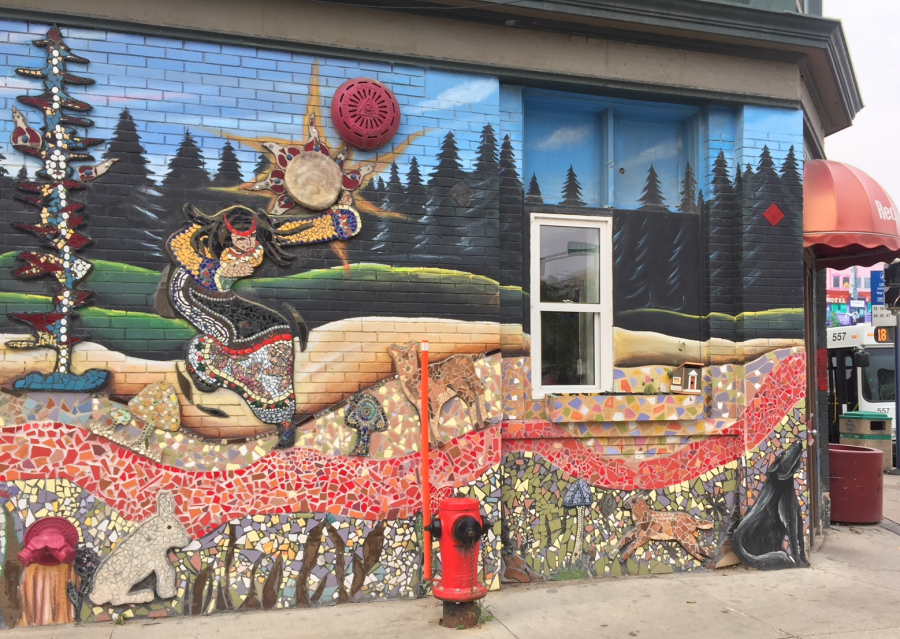
In September, the CCID’s CEO, Tasso Evangelinos, and Social Development manager, Pat Eddy, attended what has become an annual event for the organisation: the International Downtown Association (IDA) Conference, this year held in Winnipeg, Canada.
Commenting on the destination for this year's conference, Pat notes: “Winnipeg is currently working very hard to reimagine their downtown, after a period during which it became quite run down and neglected. It's known to locals as the "Authenticity”, and is working hard to come to terms with the inequalities and poverty of the past. It has a large Aboriginal population (around 11% of the total population of 1.3 million), and there is a strong emphasis on social justice as the city strives to embrace its own diversity."
"It is a city that was born out of trading, and is today also a manufacturing destination as well as a transportation hub: its population is incredibly diverse,” says Tasso, “from the original North American Indian tribes, to the large numbers of French and English that arrived thereafter. There are also Scots, Irish, Germans, Sikh Indians and a large Ukrainian community. The official languages are French and English.
“However, it is also a city still quite divided, with many social issues, particularly in the inner city and mostly drug and alcohol related.”
Having attended a number of conference sessions as well as a walking tour dealing with social issues, Pat notes: “It was very surprising to see that so many of the challenges Winnipeg faces are very similar to our own in Cape Town.”
Among these, according to Pat, is a substantial amount of violent crime associated with gangs and drugs: “Attempted murders, aggravated assaults with weapons and sexual offences are apparently on the increase. Substance abuse and particularly opioid dependency is a growing concern with people openly injecting in public spaces. All too familiar to the issues we are encountering in Cape Town.”
So, too, is homelessness, with the Canadian solution being a “housing first” approach.
Says Pat: “There is not that much faith among locals in their current shelter system and authorities are increasingly finding that a large percentage of those living on the streets are not interested in utilising the services of a shelter. As a result, Winnipeg wants to move completely away from the shelter model to the housing first model.
“Interestingly, big business and particularly property developers are preparing to buy up derelict buildings and hotels and – with the support of local government – convert these into affordable accommodation for people living on the streets.”

Government was also very accommodating to small new businesses, supporting these by enabling them to be rent-free for their first few months in operation, until they had proven their sustainability.
For Tasso, sessions involving the collection and evaluation of data, research methods being used in downtowns abroad as well as a session which looked at calculating the value of downtowns to both the local economy and a city were especially valuable: “Precinct management is a growing phenomenon, worldwide. Downtowns are becoming increasingly more prominent and powerful as the world urbanises at a fast rate - but of course, this also brings many new challenges.”
Among these were fast-growing and often new downtown residential communities. In terms of Winnipeg, one of the things that struck Pat was that the city had many large apartment blocks: “More than 68% of all accommodation is rental, and – like the Cape Town Central City – it was now experiencing a fair amount of residential influx back into its downtown area.

“I attended a session called ‘Wake up and smell the residents’ where a number of global challenges facing city improvement districts (CIDs) - or rather business improvement districts (BIDs) as they are more commonly known abroad - in the wake of this residential movement where highlighted.”
Among these are the fact that many cities are struggling to adapt to the fast pace of residential complexes being built in their traditional downtown areas and are having to realise that these areas are no longer strictly business improvement districts but that they are instead fast becoming mixed-use areas.
“As a result,” notes Pat, “many improvements districts that were previously BIDs are changing to Community Development Districts (CDDs).”
The session also highlighted the need for BIDs and CIDs to be welcoming to new owners and actively engage with them through meetings and welcome packs. “There is a need to understand that the voices of residents are important as they have a financial stake in an area. It was also noted that municipal policies also sometimes failed to keep up with growing residential communities, and local governments needed to engage residents in public policy discussions.”
Other suggestions brought to the fore in the session included the need to activate parks and public spaces, and to discourage crime. A strong emphasis was also placed on the need to advocate for affordable housing and to consider creative solutions towards crises such as homelessness.
Says Tasso: “The annual IDA conference is an incredibly valuable experience. Not only does it provide global network opportunities and exposure to new ideas, but it also enables downtowns to debate common areas of interest and hear how they each approach the same challenges that we have here in Cape Town. It also really shows that we are not alone in these challenges and that, collectively as South Africa, we are doing phenomenal work right up there with the best in the world.”
Images of Winnipeg courtesy of Pat Eddy.